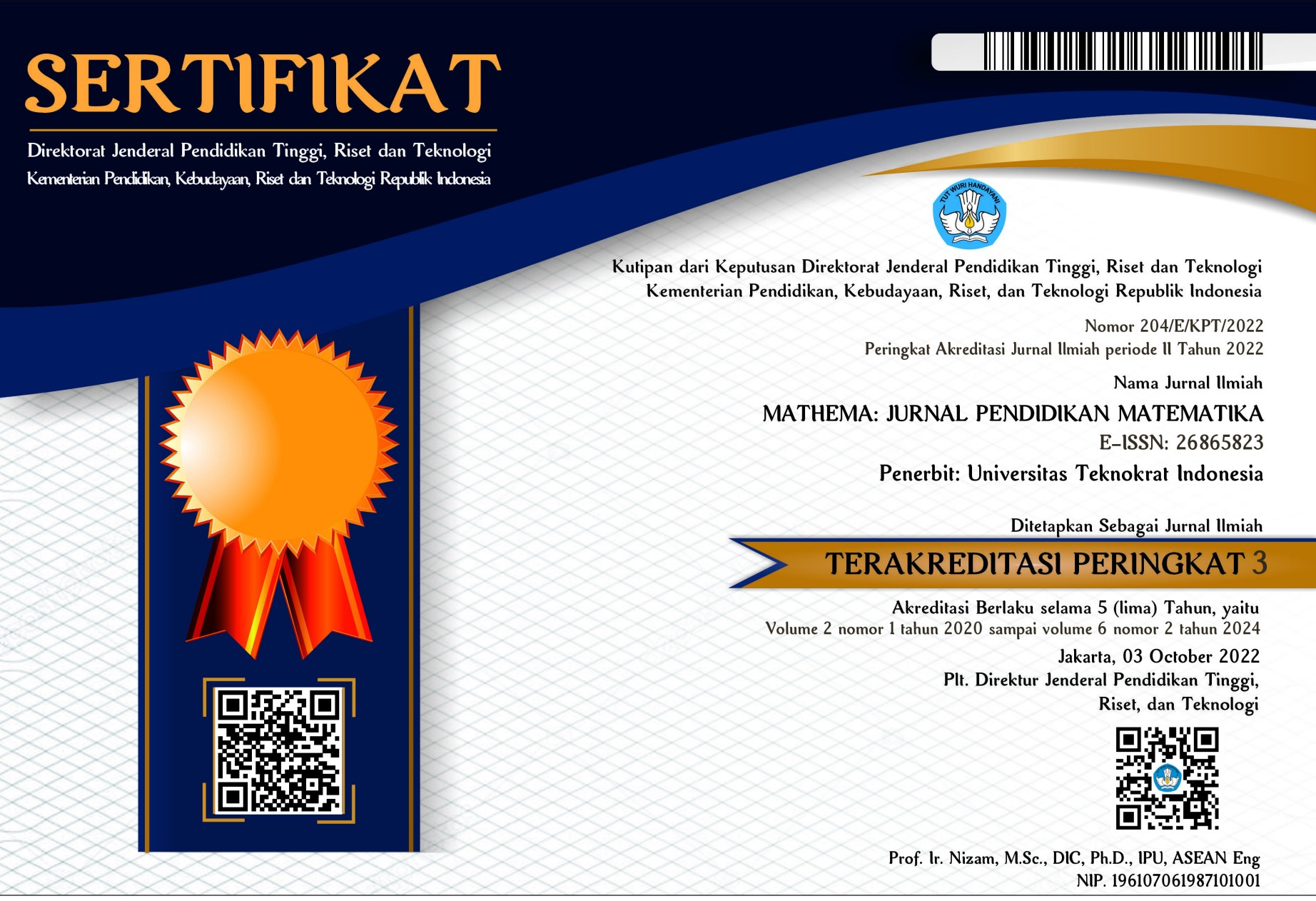
| Accreditation Certificate |
| Supported by: |
TEMPLATE IN ENGLISH

| ABSTRACTING AND INDEXING |
|
|
| VISITORS |







| VISITORS STAT |

Mathema: Jurnal Pendidikan Matematika is committed to maintaining the integrity, transparency, and credibility of scholarly publishing. All allegations of research misconduct are taken seriously and handled fairly, confidentially, and in accordance with established publication ethics principles.
Research misconduct includes actions that undermine the integrity, reliability, or originality of research and scholarly publication in Mathema. Examples include, but are not limited to:
Honest errors, differences in scientific interpretation, or legitimate methodological disagreements do not automatically constitute research misconduct. Each allegation is assessed based on the available evidence and circumstances.
Any individual who has reasonable concerns about possible research misconduct in a manuscript submitted to or published by Mathema may report the matter to the editorial office.
Reports should include as much relevant information as possible, such as:
Mathema encourages reports made in good faith and will not tolerate deliberate attempts to make malicious or knowingly false allegations against authors, reviewers, editors, or other researchers.
Upon receiving an allegation, the editor or an appropriately designated editorial representative will conduct a preliminary assessment to determine whether the concern falls within Mathema's remit and whether sufficient information is available to proceed.
The assessment may include checking the submitted manuscript, published article, research data, similarity reports, images, citations, author declarations, and other relevant evidence.
If the allegation is outside Mathema's remit or lacks sufficient supporting information, Mathema may request clarification or close the matter with an appropriate explanation.
When an allegation warrants further examination, Mathema will conduct a fair and impartial assessment. Depending on the nature and seriousness of the concern, the procedure may include:
Mathema's investigation is intended to determine the appropriate editorial response. It does not replace a formal institutional investigation where one is necessary.
Allegations will be handled confidentially to the extent reasonably possible and consistent with a fair investigation. Information will be shared only with individuals or organizations that need it to assess or resolve the concern, subject to applicable legal and ethical obligations.
Mathema will seek to protect the rights and reputations of complainants and individuals accused of misconduct. An allegation will not be treated as proof of wrongdoing, and no adverse conclusion will be reached without an appropriate assessment of the available evidence.
Mathema does not permit retaliation against individuals who raise genuine concerns in good faith or cooperate with an investigation.
Depending on the nature, severity, and findings of the investigation, Mathema may take one or more of the following actions:
Editorial actions will be proportionate to the findings and intended to protect the integrity of the scholarly record. Retractions, corrections, and expressions of concern will be handled in accordance with Mathema's relevant policies.
Authors must ensure that their research is accurately reported, original work is appropriately cited, data are represented honestly, and all required ethical and funding declarations are complete.
Reviewers should report credible concerns about plagiarism, data integrity, ethical compliance, or other potential misconduct to the editor and should not conduct unauthorized investigations or disclose confidential information.
Editors must assess allegations objectively, manage conflicts of interest, maintain appropriate confidentiality, and take reasonable steps to protect the integrity of the publication process.
Individuals who disagree with an editorial decision arising from an allegation may submit a reasoned appeal to the editorial office, supported by relevant evidence or clarification.
The appeal will be reviewed by an editor or an appropriately designated person who is not directly conflicted by the matter. Mathema may seek independent advice when necessary.
Mathema may refer unresolved concerns to the appropriate research institution or other competent body when a formal investigation is necessary.
Mathema handles allegations of research misconduct in accordance with its publication ethics policies and relevant principles and guidance from the Committee on Publication Ethics (COPE).
This policy may be applied alongside Mathema's policies on plagiarism, authorship and contributorship, corrections and retractions, conflicts of interest, and research ethics.
| Accreditation Certificate |
| Supported by: |
TEMPLATE IN ENGLISH
| ABSTRACTING AND INDEXING |
|
|
| VISITORS |
| VISITORS STAT |