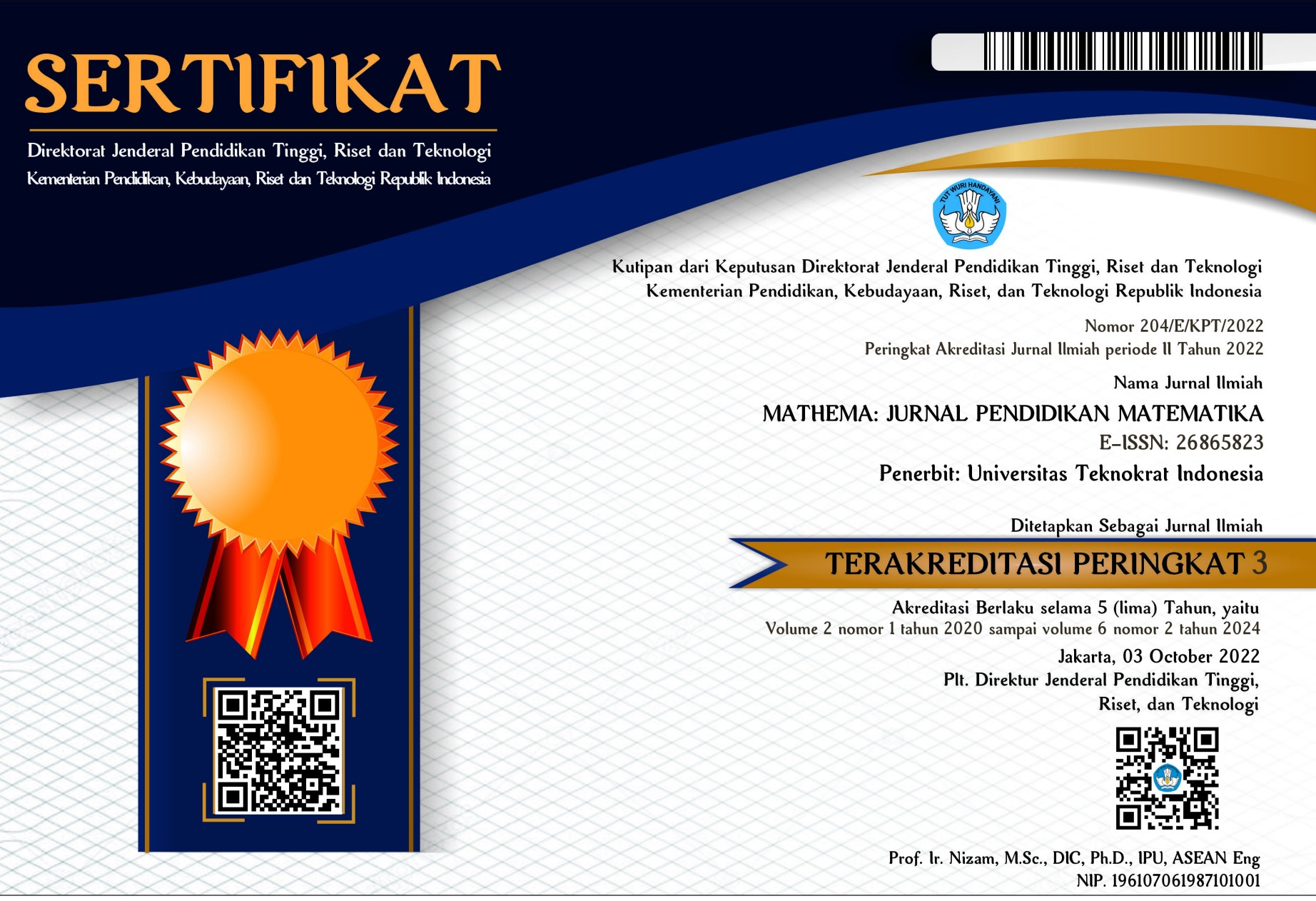
| Accreditation Certificate |
| Supported by: |
TEMPLATE IN ENGLISH

| ABSTRACTING AND INDEXING |
|
|
| VISITORS |







| VISITORS STAT |

Mathema is committed to ensuring transparency, objectivity, and integrity throughout the research and publication process. All authors, reviewers, and editors must disclose any financial, professional, personal, or institutional relationships that could influence, or reasonably be perceived to influence, their judgment or decisions.
A conflict of interest exists when personal, financial, professional, academic, or institutional interests could improperly influence an individual's responsibilities in conducting, reviewing, editing, or publishing scholarly research in Mathema.
A conflict of interest does not necessarily imply misconduct. However, failure to disclose a relevant conflict may compromise the transparency and credibility of the publication process.
Mathema requires all relevant conflicts to be disclosed so that they can be assessed and managed appropriately.
Conflicts of interest may include, but are not limited to, the following:
This list is not exhaustive. Any relationship that could reasonably be perceived as influencing professional judgment should be disclosed.
All authors must disclose relevant actual, potential, or perceived conflicts of interest at the time of manuscript submission to Mathema.
Authors are responsible for:
The corresponding author is responsible for coordinating the collection and submission of conflict-of-interest declarations from all co-authors.
Reviewers must disclose any actual, potential, or perceived conflicts of interest before accepting a peer-review assignment for Mathema.
Reviewers should decline the assignment when a conflict could compromise, or reasonably be perceived to compromise, their impartiality. Relevant situations may include recent collaboration with the authors, close personal relationships, direct competition, or financial interests related to the research.
Reviewers must maintain confidentiality and must not use unpublished information obtained during peer review for personal, professional, or financial advantage.
Editors must make editorial decisions objectively and independently, based on the manuscript's scholarly merit, relevance, originality, and compliance with Mathema's policies.
Editors must disclose relevant conflicts and withdraw from handling a manuscript when their impartiality may be compromised. In such cases, the manuscript should be assigned to an independent editor or another appropriately qualified editorial representative.
Editors must not use confidential information obtained through editorial duties for personal benefit or allow commercial, personal, or institutional interests to improperly influence publication decisions.
Authors must include a conflict-of-interest statement in their manuscript. If no relevant conflict exists, the following statement may be used:
No Conflict of Interest:
"The authors declare that they have no known financial or non-financial competing interests that could have appeared to influence the work reported in this manuscript."
Conflict of Interest Disclosed:
"The authors declare the following competing interests: [describe the relevant financial or non-financial interests]. The role of the relevant organization or sponsor in the research and manuscript preparation is disclosed as follows: [provide details, where applicable]."
The declaration must accurately reflect the circumstances of the research. Authors should not use the no-conflict statement if a relevant conflict exists.
Mathema will assess disclosed conflicts and determine whether additional measures are necessary to protect the integrity of the editorial process. Depending on the circumstances, appropriate measures may include:
All decisions will be made proportionately and in accordance with Mathema's publication ethics policies.
If a previously undisclosed conflict of interest is identified after submission or publication, Mathema may request an explanation and supporting information from the authors or other relevant individuals.
Depending on the findings, Mathema may require a correction, publish an appropriate editorial notice, reconsider an editorial decision, or take other measures consistent with its publication ethics and corrections policies.
Serious concerns involving potential research or publication misconduct will be assessed in accordance with Mathema's procedures for allegations of research misconduct.
All authors, reviewers, and editors are expected to comply with this policy and to disclose relevant conflicts in a timely and transparent manner.
Mathema handles conflicts of interest in accordance with its publication ethics policies and relevant guidance from the Committee on Publication Ethics (COPE). This policy should be read alongside Mathema's policies on authorship, peer review, research ethics, and allegations of research misconduct.
| Accreditation Certificate |
| Supported by: |
TEMPLATE IN ENGLISH
| ABSTRACTING AND INDEXING |
|
|
| VISITORS |
| VISITORS STAT |