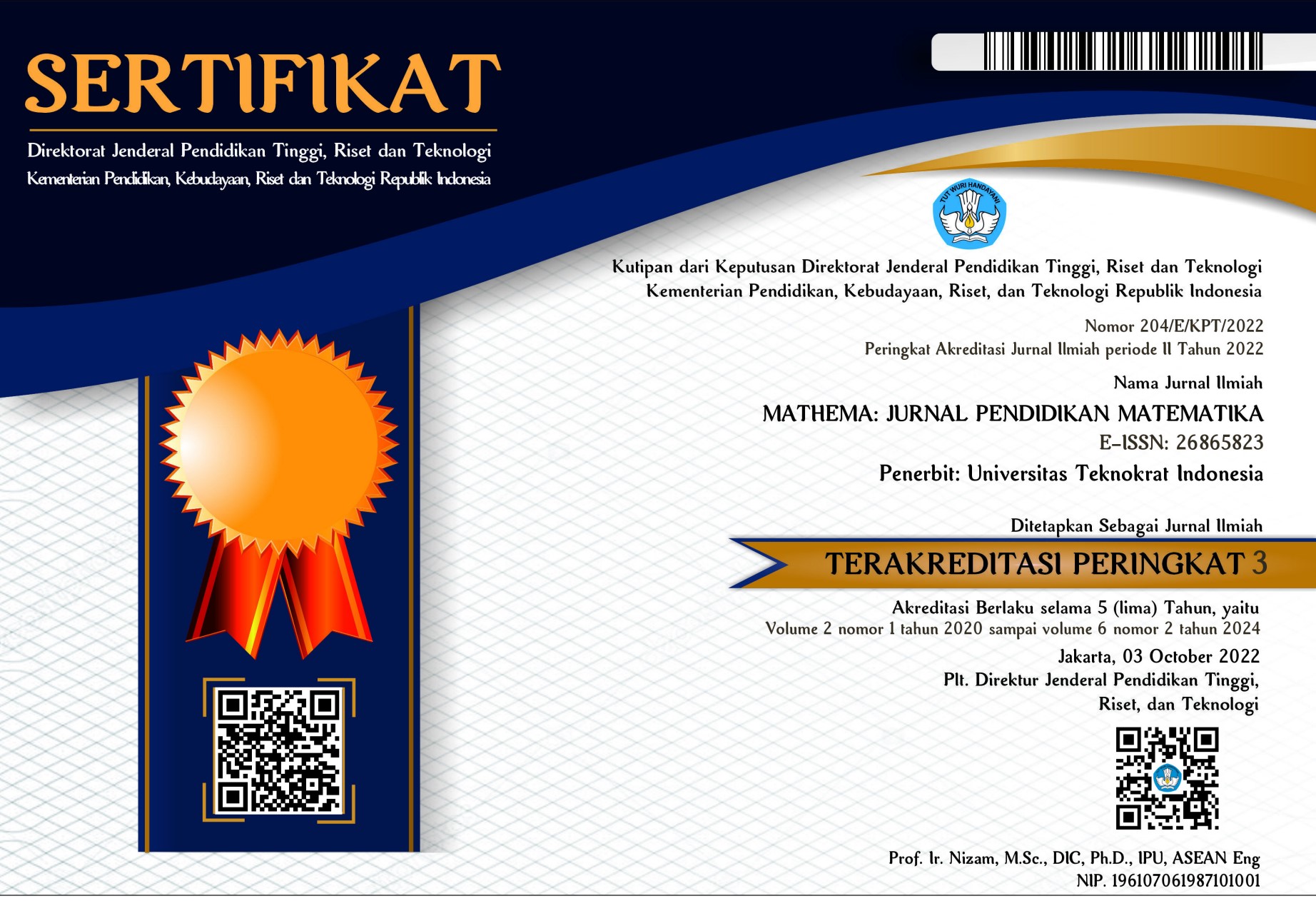
Prospective Mathematics Teachers’ Creativity in Developing Mathematics Problems Based on Ethnomathematics Context and AKM Framework
Abstract
Developing instrument tests is an important skill for prospective teachers. The implementation of the Merdeka Curriculum is a means to meet 21st-century skills, one of which is numeracy literacy. This study aims to describe the creativity of prospective teachers and the cognitive level of the developed mathematics problem oriented with Minimum Competency Assessment (AKM) using ethnomathematics context. This qualitative research employed a phenomenological approach, with subjects 7th-semester prospective teachers at an Islamic higher education. Stratified random sampling and maximum variation sampling techniques were used to select 12 students from 96 based on prerequisite course grades. Student creativity in constructing problems was assessed using rubrics based on creativity indicators: fluency, flexibility, and elaboration. The Gwet AC1 Coefficient was used to ensure agreement on the scoring results. Based on the fluency indicator, the results showed that the algebra content was the most difficult to develop, while the measurement and geometry content was the easiest. Based on the flexibility indicator, the majority of the problems were at the application level, and the fewest were at the reasoning level. Considering the level of problems, content on measurement & geometry, data & uncertainty, and algebra were least frequently developed into reasoning-level problems. Based on the problem type in the elaboration indicator, the majority of students developed problems that did not contain new additional information. The least frequently developed problem type was one that included additional information but was not necessary to solve the problem. The findings of this study imply the necessity of measuring teachers' numeracy literacy skills before students' numeracy literacy is developed and measured, as well as the importance of problem development training.
References
Abdussalam, A.K. (2006). Mengembangkan Kreativitas Anak. Pustaka Al-Kautsar.
Akpur, U. (2020). Critical, reflective, creative thinking and their reflections on academic achievement. Thinking Skills and Creativity, 37, 100683. https://www.sciencedirect.com/science/article/abs/pii/S1871187120301577
Almazroa, H., & Alotaibi, W. (2023). Teaching 21st century skills: Understanding the depth and width of the challenges to shape proactive teacher education programmes. Sustainability, 15(9), 7365. https://doi.org/10.3390/su15097365
Barton, B. (1996). Barton, B. (1996). Ethnomathematics: Exploring cultural diversity in mathematics (Disertasi). University of Auckland, Auckland, New Zealand.
Beswick, K., & Fraser, S. (2019). Developing mathematics teachers’ 21st century competence for teaching in STEM contexts. ZDM-Mathematics Education, 51, 955–965. https://doi.org/10.1007/s11858-019-01084-2
Bolden, D.S., Herries, T.V., & Newton, D.P. (2010). Pre-service primary teachers’ conceptions of creativity in mathematics. Educational Studies in Mathematics, 73, 143–157. https://doi.org/10.1007/s10649-009-9207-z
Cahyanovianty, A.D., & Wahidin. (2021). Analisis kemampuan numerasi peserta didik kelas VIII dalam menyelesaikan soal Asesmen Kompetensi Minimum (AKM). Jurnal Cendekia: Jurnal Pendidikan Matematika, 5(2), 1439–1448. https://j-cup.org/index.php/cendekia/article/view/651
Chapman, O. (2012). Prospective elementary school teachers ways of making sense of mathematical problem posing. PNA: Revista de Investigación En Didáctica de La Matemática, 6(4), 135–146.https://doi.org/10.30827/pna.v6i4.6137
Cremin, T., & Chappell, K. (2021). Creative pedagogies: A systematic review. Research Papers in Education, 36(3), 299–331. https://doi.org/10.1080/02671522.2019.1677757
Creswell, J.W. (2015). Educational Research: Planning, Conducting, and Evaluating Quantitative and Qualitative Research (5th ed). Upper Saddle River, NJ: Pearson.
Christou, C., Mousoulides, N., Pittalis, M., Pitta-Pantazi, D., & Sriraman, B. (2005). An empirical taxonomy of problem posing processes. ZDM - International Journal on Mathematics Education, 37(3), 149–158. https://doi.org/10.1007/s11858-005-0004-6
D’Ambrosio. (1990). Etnomatematica. Sao Paulo, SP: Editora Atica.
DeVink, I.C., et al. (2022). Creativity in mathematics performance: The role of divergent and convergent thinking. British Journal of Education Psychology, 92, 484–501. https://doi.org/10.1111/bjep.12459
Direktur Jenderal Pendidikan Islam. (2018). Panduan Pengembangan Kurikulum PTKI Mengacu pada KKNI dan SN-Dikti. Retrieved from http://diktis.kemenag.go.id/NEW/file/dokumen/2815324462893281MFULL.pdf
Dunn, J.A. (1975). Tests of creativity in mathematics. International Journal of Mathematics Education in Science and Technology, 6(3), 327–332. https://doi.org/10.1080/0020739750060310
Erdriani, D., & Devita, D. (2019). Analisis Kesulitan Mahasiswa dalam Menyelesaikan Soal pada Materi Pertidaksamaan dan Fungsi Limit. Edumatika: Jurnal Riset Pendidikan Matematika, 2(1), 52. https://doi.org/10.32939/ejrpm.v2i1.330
Fauziah, A., Sobari, E.F.D., & Robandi, B. (2021). Analisis pemahaman guru Sekolah Menengah Pertama (SMP) mengenai Asesmen Kompetensi Minimum (AKM). EDUKATIF: Jurnal Ilmu Pendidikan, 3(4), 1550–1558. https://doi.org/10.31004/edukatif.v3i4.608
Fraenkel, J.R., Wallen, N.E., & Hyun, H.H. (2023). How to Design and Evaluate Research in Education (11th ed.). New York, NY: Mc Graw Hill.
Gal, I., Grotlüschen, A., Tout, D., & Kaiser, G. (2020). Numeracy, adult education, and vulnerable adults: A critical view of a neglected field. ZDM-Mathematics Education, 52, 377–394. https://doi.org/10.1007/s11858-020-01155-9
Gontijo, C.H. (2018). Mathematics education and creativity: A point of view from the systems perspective on creativity. In Broadening the Scope of Research on Mathematical Problem Solving: A Focus on Technology, Creativity and Affect (pp. 375–386). Springer.
Gwet, K.L. (2014). Handbook of Inter-Rater Reliability (4th ed). Gaithersburg, MD: Advanced Analytics, LLC.
Haylock, D.W. (1987). A framework for assessing mathematical creativity in school children. Educational Studies in Mathematics, 18(1), 59–74. https://doi.org/10.1007/BF00367914
Imelda, I. (2018). Analisis Kesulitan Mahasiswa Dalam Menyelesaikan Soal Pemecahan Masalah Pada Mata Kuliah Aljabar Dan Trigonometri. MES: Journal of Mathematics Education and Science, 4(1), 49–50. https://doi.org/10.30743/mes.v4i1.868
Indonesian Mathematics Education Society. (2024). Panduan Penyusunan Dokumen Kurikulum S1 dan S2 Pendidikan Matematika. Retrieved from https://i-mes.org/wp-content/uploads/2024/12/20241212-Panduan-Penyusunan-Dokumen-Kurikulum-S1-dan-S2-Pendidikan-Matematika-I-MES.pdf
Ismail, R., Retnawati, H., Arovah, N. I., & Imawan, O. R. (2024). Contexts proposed by teachers in Papua for developing mathematics HOTS assessment instruments: A phenomenological study. 2024, 11(3), 548–556. https://doi.org/10.20448/jeelr.v11i3.5922
Işik, C., Kar, T., Yalçin, T., & Zehir, K. (2011). Prospective teachers’ skills in problem posing with regard to different problem posing models. Procedia - Social and Behavioral Sciences, 15, 485–489. https://doi.org/10.1016/j.sbspro.2011.03.127
Jailani, J., Retnawati, H., Rafi, I., Mahmudi, A., Arliani, E., Zulnaidi, H., Abd Hamid, H. S., & Prayitno, H. J. (2023). A phenomenological study of challenges that prospective mathematics teachers face in developing mathematical problems that require higher-order thinking skills. Journal of Mathematics, Science and Technology Education, 19(10), 1–21. https://doi.org/10.29333/ejmste/13631
Johnson, R.B., & Christensen, L. (2020). Educational Research: Quantitative, Qualitative and Mixed Approaches (7th ed.). Thousand Oaks, CA: SAGE.
Kepala Badan Standar, Kurikulum dan Asesmen Pendidikan. (2023). Framework Asesmen Kompetensi Minumum (AKM). Pusat Asesmen Pendidikan. Retrieved from https://pusmendik.kemdikbud.go.id/pdf/file-153
Kohar, A. W., Rahaju, E. B., & Rohim, A. (2022). Prospective teachers’ design of numeracy tasks using a physical distancing context. Journal on Mathematics Education, 13(2), 191–210. https://doi.org/10.22342/jme.v13i2.pp191-210
Kontorovich, I., Koichu, B., Leikin, R., & Berman, A. (2011). Indicator of creativity in mathematical problem posing: How indicative are they? Proceedings of the 6th International Conference Creativity in Mathematics Education and the Education of Gifted Students, 120–125. https://www.researchgate.net/publication/269466270_Indicators_of_creativity_in_mathematical_problem_posing_How_indicative_are_they
Kupers, E., Lehmann-Wermser, A., McPherson, G., & Van Geert, P. (2019). Children creativity: A theoritical framework and systematic review. Review of Educational Research, 89(1), 93–124. https://doi.org/10.3102/0034654318815707
Laurens, T. (2016). Analisis etnomatematika dan penerapannya dalam meningkatkan kualitas pembelajaran. LEMMA, 3(1), 86–96. https://www.neliti.com/id/publications/145598/analisis-etnomatematika-dan-penerapannya-dalam-meningkatkan-kualitas-pembelajara
Lee, K. H., Lee, E. J., & Park, M. S. (2016). Task modification and knowledge utilization by Korean prospective mathematics teachers. Pedagogical Research, 1(2), 54. https://doi.org/10.20897/lectito.201654
Leikin, R. (2009). Exploring mathematical creativity using multiple solution task. In Creativity in mathematics and the education of gifted students (pp. 129–135). Rotterdam: Sense Publishers.
Leikin, R. (2016). Interplay between creativity and expertise in teaching and learning of mathematics. Proceedings of the 40th Conference of International Group for the Psychology of Mathematics Education. Presented at the 40th Conference of International Group for the Psychology of Mathematics Education, Szeged, Hungary. Szeged, Hungary: PME.
Leikin, R., & Aizik, R. (2019). Creativity and openness as indicators of professional growth of leaders in communities of practice of teachers who teach the high-level track of high school mathematics. In International Handbook of Mathematics Teacher Education (Vol. 3, pp. 81–102). Brill.
Lev-Zamir, H., & Leikin, R. (2011). Creative mathematics teaching in the eye of the beholder: Focusing on teachers’ conceptions. Research in Mathematics Education, 13(1), 17–32. https://doi.org/10.1080/14794802.2011.550715
Lubis, A.N.M.T, et al. (2021). The ability to solve mathematical problems through realistic mathematics learning based on ethnomathematics. Journal of Physics: Conference Series, 1731(1), 012050. https://doi.org/10.1088/1742-6596/1731/1/012050
Marsigit. (2016). Pengembangan Pembelajaran Matematika Berbasis Etnomatematika. Prosiding Seminar Nasional Matematika Dan Pendidikan Matematika 2016 STKIP PGRI Sumatera Barat Dengan Tema Etnomatematika, Matematika Dalam Perspektif Sosial Dan Budaya. Presented at the Seminar Nasional Matematika dan Pendidikan Matematika 2016 STKIP PGRI Sumatera Barat, Padang, Indonesia. Padang, Indonesia: STKIP PGRI Sumatera Barat.
Meier, M.A., & Grabner, R.H. (2022). The roles of intelligence and creativity for learning mathematics. In Handbook of Cognitive Mathematics (pp. 1–37). Cham: Springer International Publishing.
Menteri Pendidikan dan Kebudayaan Republik Indonesia. (2019). Peraturan Menteri Pendidikan dan Kebudayaan Republik Indonesia Nomor 43 tahun 2019 tentang Penyelenggaraan Ujian yang Diselenggarakan Satuan Pendidikan dan Ujian Nasional. Retrieved from https://pendidikan.kulonprogokab.go.id/files/Permendikbud%20No%2043%20Tahun%202019.pdf
Menteri Pendidikan Kebudayaan Riset dan Teknologi. (2021). Peraturan Menteri Pendidikan Kebudayaan Riset dan Teknologi No. 17 Tahun 2021 tentang Asesmen Nasional. Retrieved from https://peraturan.bpk.go.id/Home/Details/175175/permendikbud-no-17-tahun-2021
Menteri Pendidikan Kebudayaan Riset dan Teknologi. (2022). Peraturan Menteri Pendidikan Kebudayaan Riset dan Teknologi No. 21 Tahun 2022 tentang Standar Penilaian Pendidikan dan Pendidikan Anak Usia Dini, Jenjang Pendidikan Dasar dan Jenjang Pendidikan Menengah. Retrieved from https://jdih.kemdikbud.go.id/sjdih/siperpu/dokumen/salinan/salinan_20220523_140932_SALINAN_Permendikbudristek%20No_21%20Tahun%202022_%20Standar%20Penilaian%20Pendidikan%20(jdih.kemdikbud.go.id).pdf
Menteri Pendidikan Kebudayaan Riset dan Teknologi. (2023). Peraturan Menteri Pendidikan, Kebudayaan, Riset, dan Teknologi Nomor 53 Tahun 2023 tentang Penjaminan Mutu Pendidikan Tinggi. Retrieved from https://peraturan.bpk.go.id/Details/265158/permendikbudriset-no-53-tahun-2023
Miller, M.D., Linn, R.L., Gronlund, N.E. (2009). Measurement and Assessment in Teaching. Pearson.
Mufidah, A., Sulasteri, S., Majid, A. F., & Mattoliang, L. A. (2019). Analisis pemahaman konsep aljabar pada mata kuliah Aljabar Linear Elementer. Al Asma : Journal of Islamic Education, 1(1), 42. https://doi.org/10.24252/asma.v1i1.11247
Nadjafikhah, M., Yaftian, N., & Bakhshalizadeh, S. (2012). Mathematical creativity: Some definitions and characteristics. Procedia - Social and Behavioral Sciences, 31, 285–291. https://doi.org/10.1016/j.sbspro.2011.12.056
Nahdi, D. S., Jatisunda, M. G., Cahyaningsih, U., & Suciawati, V. (2020). Pre-service teacher’s ability in solving mathematics problem viewed from numeracy literacy skills. Ilkogretim Online, 19(4), 1902. https://doi.org/10.17051/ilkonline.2020.762541
Nugraheni, N., Sukestiyarno, Y. L., Wardono, W., & Masrukan, M. (2023). Mathematical ability profiles in solving numeracy problems. International Journal of Education and Research, 11(11), 1–12. https://ijern.com/journal/2023/November-2023/01.pdf
Nurhandayani, S. (2022). Pengaruh Pembelajaran Pengajuan masalah pada pemahaman konsep matematika dan keterampilan berpikir kritis untuk siswa kelas 8. Prima Magistra: Jurnal Ilmiah Kependidikan, 3(4), 350–358. https://doi.org/10.37478/jpm.v3i4.1826
Olson, R.W. (1996). Seni Berpikir Kreatif: Sebuah Pedoman Praktis, terj. Alfonsus Samosir. Jakarta: Erlangga.
Pitta-Pantazi, D., & Christou, C. (2011). The structure of prospective kindergarten teachers’ proportional reasoning. Journal of Mathematics Teacher Education, 14(2), 149–169. https://doi.org/10.1007/s10857-011-9175-y
Presiden Republik Indonesia. (2005). Undang-undang Republik Indonesia Nomor 14 Tahun 2005 tentang Guru dan Dosen. Retrieved from https://jdih.usu.ac.id/phocadownload/userupload/Undang-Undang/UU%2014-2005%20Guru%20dan%20Dosen.pdf
Rafi, I., & Sugiman, S. (2019). Problem posing ability among prospective mathematics teachers. PYTHAGORAS:Jurnal Pendidikan Matematika, 14(2), 188–198. https://doi.org/10.21831/pg.v14i2.29976
Rokhim, D.A., Rahayu, B.N., Alfiah, L.N., Peni, R., Wahyudi, B., Wahyudi, A., ... & Widarti, H.R. (2021). Analisis kesiapan peserta didik dan guru pada Asesmen Nasional (Asesmen Kompetensi Minimum, Survey Karakter, dan Survey Lingkungan Belajar). JAMP: Jurnal Administrasi Dan Manajemen Pendidikan, 4(1), 61–71. http://dx.doi.org/10.17977/um027v4i12021p61
Rosa, M & Orey, D.C. (2011). Ethnomathematics: The cultural aspects of mathematics. Revista Latinoamericana de Etnomatematica, 4(2), 32–54. https://www.researchgate.net/publication/277262543_Ethnomathematics_The_cultural_aspects_of_mathematics
Sari, D.R., Lukman, E.N.A., & Muharram, M.R.W. (2021). Analisis kemampuan siswa dalam menyelesaikan soal geometri pada Asesmen Kompetensi Minimum Numerasi Sekolah Dasar. FONDATIA, 5(2), 153–162. https://doi.org/10.36088/fondatia.v5i2.1387
Sari, Y. M., Kohar, A. W., El Milla, Y. I., Fiangga, S., & Rahayu, D. S. (2024). Aligning numeracy task design with SDG Goals: Nutrition facts as a context for prospective mathematics teachers’ problem posing. Journal on Mathematics Education, 15(1), 191–206. https://doi.org/10.22342/jme.v15i1.pp191-206
Sari, Y. M., Saadah, N., & Hanifah, U. (2024). Analysis of the quality of problems posed by prospective mathematics teacher students when designing numeracy problems. Library of Progress-Library Science, Information Technology & Computer, 44(3), 3784. https://bpasjournals.com/library-science/index.php/journal/article/view/1208
Şengül, S., & Katrancı, Y. (2014). Structured problem posing cases of prospective mathematics teachers: Experiences and suggestions. International Journal on New Trends in Education and Their Implications, 5(4), 190–204. https://www.researchgate.net/publication/357752178_STRUCTURED_PROBLEM_POSING_CASES_OF_PROSPECTIVE_MATHEMATICS_TEACHERS_EXPERIENCES_AND_SUGGESTIONS
Setiawati, E. (2014). Mengembangkan kemampuan berpikir logis, kreatif, dan habits of mind matematis melalui pembelajaran berbasis masalah: Eksperimen terhadap siswa Madrasah Aliyah (Phd, Universitas Pendidikan Indonesia). Universitas Pendidikan Indonesia. Retrieved from http://repository.upi.edu
Shonia, M. I., Basir, M. A., & Wijayanti, D. (2021). Pengembangan instrumen tes penalaran aljabar berbasis Taksonomi Marzano pada materi Program Linier. Prosiding Seminar Nasional Pendidikan Sultan Agung 2 (Sendiksa 2).
Silver, E. A., & Cai, J. (2005). Assessing Students’ Mathematical Problem Posing. Teaching Children Mathematics, 12(3), 129–135. https://doi.org/10.5951/tcm.12.3.0129
Sriraman, B., Yaftian, N., & Lee, K.H. (2011). Mathematical creativity and mathematics education: A derivative of existing research. In The elements of creativity and giftedness in mathematics (pp. 119–130). Brill.
Susilo, B.E., & Widodo, S.A. (2018). Kajian etnomatematika dan jati diri bangsa. IndoMath: Indonesia Mathematics Education, 1(2), 121–128. https://www.researchgate.net/publication/327958692_Kajian_Etnomatematika_Dan_Jati_Diri_Bangsa
Tabach, M., & Friedlander, A. (2013). School mathematics and creativity at the elementary and middle-grades levels: How are they related?. ZDM-Mathematics Education, 45, 227–238. https://doi.org/10.1007/s11858-012-0471-5
Torres-Velasquez, D., & Lobo, G. (2004). Culturally responsive mathematics teaching and English language learners. Teaching Children Mathematics, 11(1), 249–255. https://tkcalifornia.org/wp-content/uploads/2022/02/culturallyresponsivemathandell.pdf
Utami, A.R., Suhendri, S., & Dian, P. (2019). Hubungan antara kreativitas guru dengan hasil belajar siswa. Jurnal Bimbingan Dan Konseling Indonesia, 3(2), 56–62. https://ejournal-pasca.undiksha.ac.id/index.php/jurnal_bk/article/view/3050
Wahyuni, A., Tias, A.A.W., & Sani, B. (2013). Peran etnomatematika dalam membangun karakter bangsa. Prosiding Seminar Nasional Matematika Dan Pendidikan Matematika. Presented at the Seminar Nasional Matematika dan Pendidikan Matematika FMIPA UNY, Universitas Negeri Yogyakarta. Universitas Negeri Yogyakarta: UNY.
Waugh, C.K., & Gronlund, N.E. (2013). Assessment of Student Achievement (10th ed.). Upper Saddle River, NJ: Pearson.
Widana, I.W., Suarta, I.M., & Citrawan, I.W. (2019). Work motivation and creativity on teacher ability to develop HOTS-based assessments. International Journal of Social Sciences and Humanities, 3(3), 188–200. https://sciencescholar.us/journal/index.php/ijssh/article/view/378
Yilmaz, R. (2020). Prospective mathematics teachers’ cognitive competencies on Realistic Mathematics Education. Journal on Mathematics Education, 11(1), 17–44. https://doi.org/10.22342/jme.11.1.8690.17-44
Yulistianti, H. D., & Megawati, E. (2019). Analisis instrumen tes higher order thinking. Jurnal Pendidikan Matematika, 13(1), 41–54.
Yustitia, V., & Siswono, T. Y. E. (2021). Numeracy of prospective elementary school teachers: A case study. Journal of Physics: Conference Series, 1918(4), 042077. https://doi.org/10.1088/1742-6596/1918/4/042077