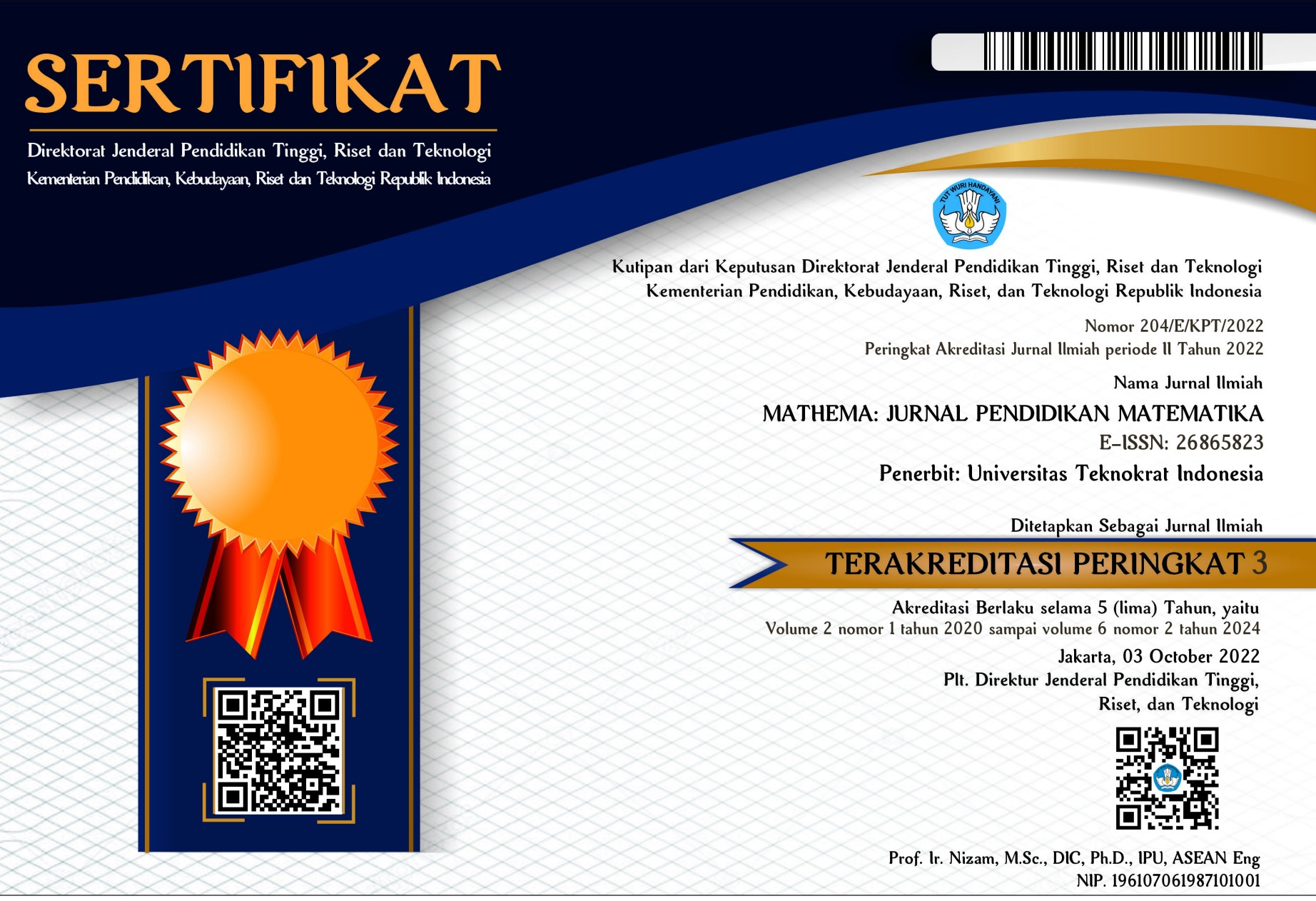
| Accreditation Certificate |
| Supported by: |
TEMPLATE IN ENGLISH

| ABSTRACTING AND INDEXING |
|
|
| VISITORS |







| VISITORS STAT |

Mathema recognizes that generative artificial intelligence (AI) and AI-assisted technologies can support authors, editors, and reviewers in certain aspects of scholarly publishing. At the same time, the use of these technologies may introduce risks related to accuracy, originality, confidentiality, authorship, research integrity, and accountability.
Mathema therefore permits responsible and transparent use of generative AI tools while maintaining the principle that all scholarly and editorial responsibilities remain with human contributors. Generative AI tools cannot replace the intellectual judgment, ethical responsibility, or accountability of authors, editors, or reviewers.
This policy applies to generative AI systems and AI-assisted technologies capable of producing or substantially modifying text, images, code, data interpretations, summaries, references, or other scholarly content.
Authors may use generative AI and AI-assisted technologies for limited and appropriate purposes during manuscript preparation. Such use must not compromise the originality, accuracy, integrity, confidentiality, or authorship of the submitted work.
Authors may use AI-assisted tools for activities such as:
The use of AI for these purposes does not transfer authorship or responsibility to the AI system.
Authors must exercise particular caution when AI tools are used to generate or substantially modify scholarly content. Authors remain fully responsible for checking all AI-assisted material before submission. This includes verification of:
AI-generated content may contain inaccurate, fabricated, incomplete, or misleading information. Authors must therefore independently verify the accuracy and relevance of any material produced or modified by an AI system.
Authors must not use generative AI in a manner that violates research integrity or publication ethics. In particular, authors must not use AI to:
The use of AI does not provide an exemption from Mathema's plagiarism, research misconduct, authorship, copyright, or publication ethics policies.
Generative AI tools, including large language models and other AI systems, cannot be listed as authors or co-authors of a manuscript.
Authorship requires human responsibility for the intellectual contribution and accountability for the published work. AI systems cannot accept responsibility for the manuscript, approve its final version, respond to questions about the research, or disclose conflicts of interest.
Authors must ensure that all individuals listed as authors meet Mathema's authorship requirements and that no AI system is presented as an author.
Authors should disclose substantive use of generative AI or AI-assisted technologies when the technology contributes to the development, modification, analysis, or presentation of manuscript content beyond routine language correction. Where disclosure is required, the author should state:
A disclosure may be included in an appropriate section of the manuscript, such as the acknowledgements, methodology, or a dedicated AI-use statement. Routine use of AI-assisted spelling, grammar, or language correction generally does not require a detailed disclosure unless the AI system substantially rewrites or generates scholarly content.
Authors are responsible for the entire content of their manuscript, including material generated, translated, edited, summarized, or modified with AI assistance. Before submission, authors must independently review AI-assisted content to ensure accuracy, genuine citations, empirical validity, and full compliance with ethical and legal requirements.
The final responsibility for the manuscript cannot be delegated to an AI system.
Authors should not enter confidential, unpublished, proprietary, personal, or otherwise sensitive research information into external generative AI systems without appropriate authorization and adequate safeguards. Particular care should be taken with unpublished datasets, participant information, proprietary research materials, and unpublished manuscripts.
Editors may use AI-assisted technologies for limited administrative or technical purposes where such use supports editorial work without compromising confidentiality, fairness, independence, or publication ethics. Editorial decisions must always remain under human control and must be based on professional judgment and Mathema's editorial policies.
Editors must protect the confidentiality of all submitted manuscripts. Editors must not upload confidential manuscript materials into external generative AI systems when doing so could expose the material to unauthorized parties or allow it to be retained/reused by service providers. This applies to:
Generative AI must not independently determine whether a manuscript should be rejected, sent for peer review, accepted, returned for revision, assigned to a specific reviewer, or handled through any substantive decision. Editors must independently evaluate manuscripts in accordance with Mathema's scope, standards, and peer-review procedures.
Editors may consider concerns about potentially AI-generated content. However, AI-detection software or automated scores must not be treated as conclusive evidence of misconduct due to potential false positives/negatives. Any concern should be assessed using multiple forms of evidence and discussed with authors for clarification.
Editors may use AI-assisted language tools for routine correspondence provided that confidential information is protected and the output is verified to be accurate, respectful, professionally appropriate, and compliant with Mathema policies.
AI tools must not influence editorial decisions in a manner that compromises editorial independence or creates unfair treatment of authors. Editors remain responsible for making impartial, evidence-based decisions.
Editors remain fully accountable for all substantive editorial decisions and communications, regardless of whether AI-assisted tools were used during the process.
Reviewers may use AI-assisted technologies only in limited circumstances and must preserve the confidentiality, integrity, and independence of the peer-review process.
Reviewers must not upload, paste, transmit, or disclose confidential manuscript content (full manuscripts, data, figures, reviewer comments, author details) to external generative AI systems.
Subject to strict confidentiality, reviewers may use limited AI tools for non-substantive tasks such as correcting grammar, improving clarity of wording, or checking readability of their own review comments.
Reviewers must not use generative AI to generate complete peer-review reports, replace their critical assessment, formulate recommendations without evaluation, fabricate criticisms, or attempt to de-anonymize author identities.
Reviewers must personally evaluate the manuscript's relevance, originality, methodology, theoretical/practical contribution, validity, and ethics. AI cannot replace scholarly expertise.
Reviewers should not use automated AI-detection tools as definitive proof of misconduct. Concerns regarding inappropriate AI use should be reported factually to the editor for further investigation.
Reviewers must protect all information obtained during peer review and must never use confidential manuscript content for personal research, competitive advantage, or commercial purposes.
The use of generative AI does not alter Mathema's strict requirements regarding research integrity. Authors, editors, and reviewers remain subject to Mathema policies concerning:
Mathema encourages complete transparency regarding substantive use of generative AI. The disclosure level should be proportionate to the role of AI in the work:
Generative AI systems cannot assume authorship, editorial responsibility, reviewer responsibility, or accountability for published scholarly work. Human contributors remain solely responsible for content accuracy, research integrity, citations, confidentiality, and ethical compliance.
Mathema may request clarification from authors, editors, or reviewers regarding the use of generative AI whenever necessary to safeguard research integrity.
Where Mathema identifies potentially inappropriate use of generative AI, the journal may request explanations, supporting evidence, or workflow clarifications. If AI use is associated with misconduct (plagiarism, fabrication, falsification, copyright violations), appropriate actions will be taken, including:
Mathema will periodically review and update this policy as generative AI technologies, scholarly publishing standards, and international publication ethics guidelines evolve. This policy is informed by recognized principles of publication ethics, research integrity, transparency, and responsible AI use in scholarly communication.
| Accreditation Certificate |
| Supported by: |
TEMPLATE IN ENGLISH
| ABSTRACTING AND INDEXING |
|
|
| VISITORS |
| VISITORS STAT |